
What Does a Red, Yellow, or Green Placard Mean After a Tornado Storm?
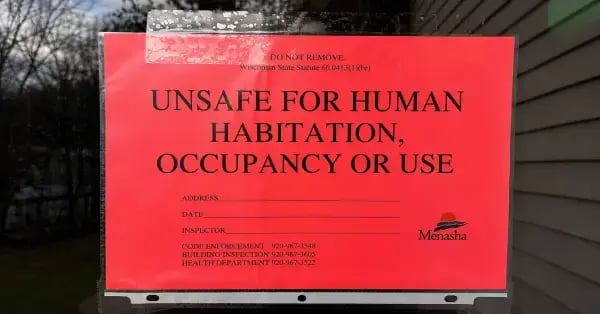
After the major tornado that just occurred in Appleton, Menasha, and Neenah, homeowners and business owners may notice colored placards appearing on damaged homes and buildings.
If you've never been through a major disaster before, seeing a red or yellow placard on your home can be alarming. Many homeowners immediately wonder:
Can I go inside? Is my home condemned? Does this mean my house has to be demolished? What does this mean for my insurance claim?
The good news is that a placard is not necessarily as scary as it may seem.
Cities and municipalities use these placards following disasters to communicate the apparent safety condition of a building. The goal is to identify obvious structural and life-safety concerns and let property owners know whether there are restrictions on using or entering a building.
The specific process can vary by community, but the basic purpose is the same: help keep people safe while damaged buildings are being evaluated.
What Do the Different Colors Mean?
While specific procedures can vary between municipalities, disaster-recovery placard systems commonly use different colors to communicate the condition of a building.
The placard guidance being used locally following the recent tornado provides a good example.
Green: Inspected
A green placard generally means that the inspection did not identify an apparent immediate hazard.
That does not mean the home has no damage.
The guidance specifically notes that repairs may still be required. A home can have significant storm damage and still receive a green placard if the inspectors do not identify conditions that require restricting occupancy.
So, don't look at a green placard and assume that everything is fine or that you don't need to file an insurance claim.
Yellow: Restricted Use
A yellow placard means there are conditions that raise safety concerns and may limit how the building can be used.
This could involve structural concerns, damaged exterior elements, water-saturated floors or ceilings, foundation concerns, or other conditions that need additional evaluation.
A yellow placard does not automatically mean a home is a total loss or that it will have to be demolished.
It means there are concerns that need to be addressed.
Red: Unsafe
A red placard indicates a more serious safety concern.
The local guidance identifies conditions such as an extreme hazard, obvious safety risks, potential collapse concerns, or other unsafe conditions. A red-placarded structure may be unsafe for occupancy or entry unless authorized by the local building department.
If you see a red placard on your home, don't take unnecessary risks trying to get inside. Contact your local building or emergency officials if you are unsure whether you can safely enter.
And there is an important distinction homeowners should understand:
A red placard is not automatically a demolition order.
The placard guidance itself specifically states:
“THIS PLACARD IS NOT A DEMOLITION ORDER.”
A Safety Inspection Is Not the Same as a Raze Order
One of the biggest questions homeowners may have after seeing a red placard is whether their home is going to be torn down.
A disaster inspection and a formal raze order are two different things.
A post-disaster inspection is primarily looking at whether a building appears safe for people to occupy or enter.
A raze order is a separate legal process. In Wisconsin, municipalities have specific procedures under Wisconsin Statute § 66.0413 for ordering a building to be razed when the statutory requirements are met.
So, receiving a disaster placard does not, by itself, mean that the city has decided your home needs to be demolished.
If you receive an actual raze order, that is a much more serious matter and you should address it promptly with the appropriate professionals.
Remember: The City Inspection Is Not a Full Inspection of Your Home
Another thing homeowners should keep in mind is the purpose and scope of the inspection.
Following a disaster, communities may need to quickly evaluate a large number of homes and buildings. These evaluations are designed to identify obvious safety concerns—not necessarily to document every piece of damage to the property.
In the recent tornado in Appleton, Menasha, and Neenah, which prompted this article, the inspections are exterior inspections from their local building departments.
That means homeowners should not assume that the placard represents a complete assessment of everything that happened to their home.
Storm damage can be much more extensive than what can be seen from the street.
There may be damage to:
- Roofing and roof decking
- Framing
- Siding and exterior walls
- Windows and doors
- Electrical systems
- Plumbing
- HVAC equipment
- Insulation
- Interior walls and ceilings
- Foundations
- Personal property
Some of that damage may not be obvious from an exterior inspection.
That's one reason why a city placard should not be treated as a determination of the total amount of damage to your home.
What Does This Have to Do With Your Insurance Claim?
Not as much as you might think.
A city or municipal inspection and an insurance claim serve different purposes.
The city is primarily concerned with:
“Is this building safe?”
Your insurance claim is concerned with questions such as:
“What was damaged?”
“What caused the damage?”
“What does the insurance policy cover?”
“What will it cost to repair or replace the damaged property?”
Those are very different questions.
For example, a home could receive a green placard because there isn't an obvious immediate safety hazard while still having thousands—or potentially hundreds of thousands—of dollars in storm damage.
Likewise, receiving a red placard does not automatically mean your insurance company will consider the home a total loss.
The city's determination of safety and your insurance company's evaluation of your claim are separate processes.
What Should You Do If Your Home Has Been Placarded?
First, don't panic.
Take a picture of the placard and document the condition of your property as thoroughly as you safely can.
If you are permitted to enter the property and it is safe to do so, take photos and videos before cleaning up or making repairs.
If the property is not safe to enter, don't put yourself in danger to document the damage.
You should also:
Contact your insurance company. Don't wait until you have everything figured out before reporting a loss.
Document the damage. Take photos and videos and make a list of damaged property.
Keep receipts. Save receipts for temporary repairs, cleanup and other expenses related to the loss.
Prevent additional damage when you safely can. Temporary repairs may be necessary to protect the property from additional damage.
Ask questions. If you're unsure what the placard means or what you should do next, talk to the appropriate city officials and your insurance professionals.
And most importantly, don't assume the placard tells you everything you need to know about your home or your insurance claim.
Don't Let the Color of a Placard Make Your Insurance Decisions for You
After a major storm, homeowners are often getting information from several different sources at once.
The city may be talking about whether the building is safe.
Your insurance company may be talking about your claim.
Contractors may be talking about repairs.
And you may be trying to figure out what you're supposed to do in the middle of all of it.
It can be overwhelming.
A placard is an important piece of information, but it is only one piece of the puzzle.
Whether your home has a green, yellow, or red placard, you still need to properly document the damage and understand what your insurance policy covers.
At Miller Public Adjusters, we work for the policyholder, not the insurance company. Our job is to help homeowners understand their coverage, document their loss and navigate the insurance claim process.
If your home was damaged by a tornado, windstorm, hailstorm or another disaster and you're not sure what to do next, we're happy to review your situation and answer your questions.
You don't have to have everything figured out before you reach out.

David Miller, Founder of Miller Public Adjusters
David Miller here. After fighting insurers post-fire, I founded Miller Public Adjusters to help policyholders like you. Ask me anything!